

There is a growing movement to recognize the rights of nature. I believe it’s time for humans to recognize the rights of nature. After all, mammals are more similar to us than different. I needed a biology course, and was turned off by biology and anatomy courses because they dissected cats. At that time, I couldn’t fathom cutting into cats because of my two pet cats. I settled for Zoology. I learned about how similar our anatomy is to that of mammals, being mammals ourselves. We have four fingers (digits) and an opposable thumb, and very similar to us, having five fingers (digits), are whales, bats, and wolves. Wolves have five toes on the front paws, and the fifth toe is called a dew claw and is often compared to the thumb, although it doesn’t touch the ground. Whales have five digits in their pectoral fins, which are homologous to fingers. The difference is that we have the opposable thumb. But why should we grant them rights of nature? The answer lies within the knowledge of indigenous people and how whales and wolves live together as families. We must consider how these beings benefit the Earth, considering how global warming is devastating the Earth and its resources. We need them, and they need us to save them.
An indigenous perspective.
The Māori indigenous people consider whales to be their ancestors. This is similar to the Ojibwa peoples of the Great Lakes who consider the wolf to be thier brother. They know this to be true because what happens to one happens to the other, and history has proven this to be true. Just as thier people were pushed off their land, so was the wolf. Just as the people began to recover and were given their rights back in the 1970s, so was the wolf beginning to come back to Wisconsin’s lands.
The Māori are fighting to recognize whales as legal persons and ocean ambassadors to the United Nations.
The stories of Te Ao Māori (the Māori worldview) are etched in the very fabric of my being. I’m a descendant of Maui, the demigod who fished up the North Island, and Paikea, our courageous ancestor who rode a whale to our new home. ~Mere Takoko, A Māori conservationist.

Image of mother and calf, credit Paul Nicklen Photography, https://paulnicklen.com/limited-edition/
Takoko talks about why they believe the whale should be granted personhood in the article A Descendant’s Call for Whale Legal Personhood. They have always lived in harmony with Moana (the sea) and believe it’s all part of the knowledge of thier ancestors passed down through generations.
Tokoko believes, “Whales aren’t just resources to be exploited, but sentient beings and our ancestors. My whakapapa (genealogy) is intricately woven with the moana; its mana (spiritual essence) flows through me. My work to protect the oceans comes from deep within.”
This account is similar to the Ojibwa people of the Great Lakes, whose creation stories are about the wolf as thier brother.
Ma’iingan is our brother, and it came about that he was our brother because that one person (Ojibwa) who was placed here to name all that, there was, he found that in a lot of things he named, he seen that there was two of them, a couple and a partner her. And so he asked the creator, well, where’s my partner? Where’s that one that I can be with so that I’m not lonely? And so he said, I’m going to send you somebody here to help you then to walk on this path and do what you need to do to name all that there is in creation. ~Edith Leoso, a Bad River Tribal member, retired from working as the Bad River Tribal Historic Preservation Officer, and cast member in People & Wolves short documentary.
Both the wolf and the whale are considered sentient beings by the Māori and the Ojibwa indigenous people, who have coexisted with them for centuries. They don’t just coexist; they have a relationship with the wolf and the whale.
Whales granted rights.
Whales benefit the ocean, which is one major reason to grant them rights and protect them.
Tokoko states that whales: “Protecting whales benefits everybody. Each great whale sequesters, on average, 33 tons of carbon, and they take that with them to the ocean floor, far away from our atmosphere, after they die. Their feces fertilize phytoplankton, which are the basis of all marine food webs and the source of oxygen for every other breath we take. Thanks to their ecological and economic services, each great whale is valued at over $2 million, according to a study by the International Monetary Fund. The value of the world’s whale stock easily exceeds $1 trillion.”
This is the same for the gray wolf. The wolf keeps other beings healthy by keeping diseases in check, such as Chronic Wasting Disease (CWD). Although their monetary value has not been established, as of yet, it should be!
Protecting the Gray wolf benefits us all.
Leoso talks about the repercussions without the wolf on the land. “So chronic wasting disease among the deer population in southern wisconsin, then would proliferate. Right? And because nothing was taking them out, thinning out those herds that were suffering from that illness. I tell people CWD is like the zombie apocalypse for the deer herd. That’s what it is. And it is Ma’ingan (wolf) who helps them, helps those deer herds. And we at Bad River have a healthy deer herd of over 200 on our reservation, and we know where they go to winter. We know that the deer herd maintains its health despite having five wolf packs on the reservation, starting with six even.”
But why should they be given rights? Humans have rights and are social beings, and have culture. What is culture? According the Merriam-Webster, culture is defined as: the customary beliefs, social forms, and material traits of a racial, religious, or social group. The characteristic features of everyday existence (such as diversions or a way of life) shared by people in a place or time.
Do animals have culture? …or social group.
It has been said that the oldest culture in the world lives in the oceans. Whales are considered the oldest culture in the world. There is new evidence that they have a language with an alphabet.
Now, a new study finds that sperm whales have far more nuanced communication than previously thought. Using machine learning, researchers at the Massachusetts Institute of Technology and a collaborative called Project CETI identified a bigger lexicon of sound patterns, like an “alphabet,” one they say could possibly be combined in ways that convey meaning, as a language does. Source: What are sperm whales saying? Researchers find a complex ‘alphabet’, May 7, 2024
Whales have a language and live in pods, having social families, and do they learn from each other?
Is there cultural transmission in whale society? Inter-species communication. A team of scientists from the SETI Institute had a conversation with a whale.
“December 12, 2023, Mountain View, CA — A team of scientists from the SETI Institute, University of California Davis, and the Alaska Whale Foundation had a close encounter with a non-human (aquatic) intelligence. The Whale-SETI team has been studying humpback whale communication systems in an effort to develop intelligence filters for the search for extraterrestrial intelligence. In response to a recorded humpback ‘contact’ call played into the sea via an underwater speaker, a humpback whale named Twain approached and circled the team’s boat, while responding in a conversational style to the whale ‘greeting signal.’ During the 20-minute exchange, Twain responded to each playback call and matched the interval variations between each signal. Source: Whale-SETI: Groundbreaking Encounter with Humpback Whales Reveals Potential for Non-Human Intelligence Communication link to the article: https://www.seti.org/news/whale-seti-groundbreaking-encounter-with-humpback-whales-reveals-potential-for-non-human-intelligence-communication/
The characteristic features of everyday existence are part of a culture. Whales learn new ways to hunt from each other, which is cultural transmission.
According to new findings in the journal Science, a team of researchers has revealed the cultural spread of new hunting techniques through a population of humpback whales over the span of 27 years.
“Our study really shows how vital cultural transmission is in humpback populations – not only do they learn their famous songs from each other, they also learn feeding techniques that allow them to buffer the effects of changing ecology,” said lead author Luke Rendell of the Sea Mammal Research Unit and Center for Social Learning and Cognitive Evolution of St. Andrews University in a press release. Second source: Mongaby, Whales teach each other new feeding behavior, by Adam Andrus, 29 May 2013. https://news.mongabay.com/2013/05/whales-teach-each-other-new-feeding-behavior/
Whales seem to be able to change with the changing ecology. Or in this case, “change with the tides.”
Do wolves learn from each other? Do wolves communicate with each other?
From my experience in tracking Wisconsin’s Gray wolf, sometimes referred to as Timber wolves, I heard them communicating with each other and me many times. I heard them howling just before sunset, heard the matriarch bark-howl rallying her pack to her, and heard a low gruff-grunt meant to warn each other of my presence. They do communicate with each other. But do they have a language?
In a study from the University of Cambridge, they found that “Wolf species have ‘howling dialects’ Source: https://www.cam.ac.uk/research/news/wolf-species-have-howling-dialects
“Wolves may not be close to us taxonomically, but ecologically, their behaviour in a social structure is remarkably close to that of humans. That’s why we domesticated dogs – they are very similar to us,” said Kershenbaum, from Cambridge’s Department of Zoology.
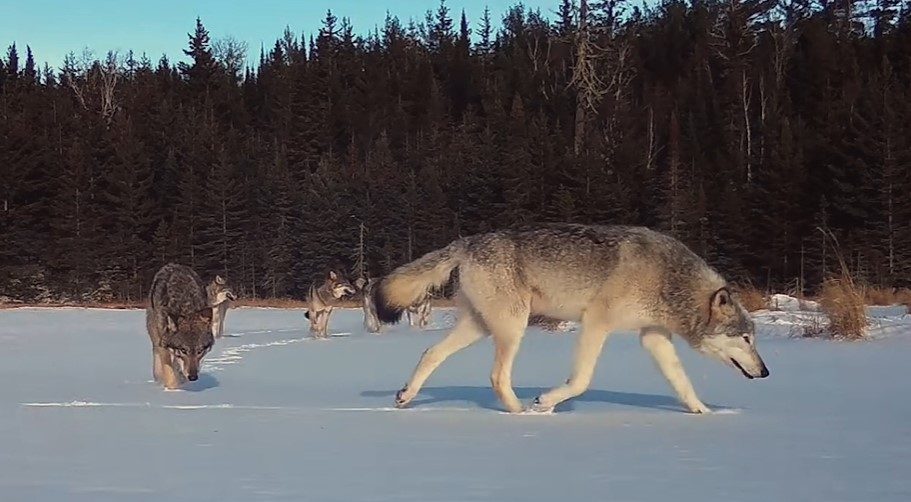
Cover photo of a wolf pack, credit Voyageurs Wolf Project.
I think we can shed a lot of light on early evolution of our own use of language by studying the vocalisation of animals that are socially and behaviourally similar to us, if not necessarily taxonomically closely related. ~Arik Kershenbaum, Lead researcher Dr Arik Kershenbaum from the University of Cambridge
The pack, the family, is a crucial part of a wolf’s life. A social sentient being, much like humans.
The following account is from Kira Cassidy, a research associate with the Yellowstone Wolf Project.
We called him Triangle, for the shape of the white blaze on his chest. Born into the last litter of the Druid Peak pack, he was smaller than his brothers and even one of his sisters. One cold morning in 2009, he and an older sister encountered three members of the Hoodoo pack deep in Druid territory. His sister was immediately attacked, but instead of running to safety, Triangle jumped into the melee twice, bit one of the Hoodoo wolves, and distracted the opposition long enough for his sister to escape. As he turned to run, he was bitten hard on a back leg but outdistanced the attackers, finally out of harm’s way.
Why would he take such a risk? In Yellowstone, 68% of natural deaths occur when two packs fight. And of the 34 attacks we witnessed and analyzed, in six cases, a wolf attempted to rescue their pack mate. So why didn’t Triangle run for safety, saving himself? It may be because the pack, the family, is a crucial part of a wolf’s life.
A case for granting rights of nature.
Animal Law, Commentary, Harvard Law. Review. “Rights of Nature, Rights of Animals” by Kristen Stilt
“Ecocentric or biocentric approaches that lodge a right in nature or its component parts also may be promising for the development of legally recognized animal rights. Rights of nature are not widespread, but they have potential for growth and impact. At the constitutional level, Ecuador was the first to recognize the rights of nature. Article 71 begins: “Nature, or Pacha Mama, where life is reproduced and occurs, has the right to integral respect for its existence and for the maintenance and regeneration of its life cycles, structure, functions, and evolutionary processes.” Bolivia adopted this approach through the Law on the Rights of Mother Earth (2010); the enumerated rights are the rights to life, diversity of life, water, clean air, equilibrium, restoration, and pollution-free living .29 Other countries have recognized the right in judicial opinions.” Source: Harvard Law Review: https://harvardlawreview.org/forum/vol-134/rights-of-nature-rights-of-animals/
Whales have rights
From the He Whakaputanga Moana Treaty (Declaration for the Ocean) source: https://ecojurisprudence.org/initiatives/he-whakaputanga-moana-declaration-for-the-ocean-treaty/
On March 28, 2024, Indigenous leaders of Aotearoa (New Zealand), the Cook Islands, Tahiti, Tonga, Hawaii, and Rapanui (Easter Island) signed a historic treaty: He Whakaputanga Moana (Declaration for the Ocean). The declaration recognizes whales as legal persons with inherent rights, including the right to freedom of movement, a healthy environment, and the ability to thrive alongside humanity.
The declarations allow the indigenous leaders to negotiate with governments to protect the whale.
While not a binding international treaty, He Whakaputanga Moana carries significant weight. The treaty will allow Māori and other Indigenous groups to start talks with governments in New Zealand, the Cook Islands, Tahiti, Tonga, and other Polynesian countries to develop a legal framework to enforce protections around whales. Conservationists believe this move will apply pressure to national governments to offer greater protections for the species. The Hinemoana Halo Ocean Initiative – the group that spearheaded the treaty – has already begun conversations with officials in Tahiti, Tonga, and the Cook Islands to persuade world leaders to follow suit.
The treaty is a significant step forward in granting rights to nature.
Where to begin.
Wisconsin has wilderness areas with an estimated 1,000 wolves in these areas. I hope that they and these areas can be granted rights of nature just as our neighbor in Minnesota, the White Earth Tribe,
has granted wild rice rights of nature.
Manoomin (“wild rice”) now has legal rights. At the close of 2018, the White Earth band of Ojibwe passed a law formally recognizing the Rights of Manoomin. According to a resolution, rights were recognized because “it has become necessary to provide a legal basis to protect wild rice and fresh water resources as part of our primary treaty foods for future generations.”
Will Wisconsin Tribes follow suit like the White Earth Tribe and grant wolves and rice rights of nature?
Our landscapes are rapidly changing due to the climate crisis, and wilderness areas are getting warmer, fluctuating with periods of drought and massive storms. At this point, we need wolves because they provide many ecological benefits, and they need us to protect them and along with other species, along with the land itself. It is for our survival!
A short by Rachel Tilseth, Never imagined I would be experiencing climate change in my lifetime…
Humans have been the leading drivers of climate change, from forest fires to floods and droughts. We are in this crisis together. Let’s find solutions together.
But why should we grant them rights of nature? The answer lies within the knowledge of indigenous people and how whales and wolves live together in family units that are very similar to ours. We must consider how these beings benefit the Earth, considering how global warming is devastating the Earth and its resources. We need them, and they need us to save them.
Regarding the “Rights of Nature,” she (Jane Goodall) advocates for recognizing that nature has inherent rights to exist, thrive, and regenerate, and that humans have a responsibility to protect these rights. ~Jane Goodall, DBE, founder of the Jane Goodall Institute and UN Messenger of Peace.
Discover more from Wolves of Douglas County Wisconsin Film Company
Subscribe to get the latest posts sent to your email.




Leave a Reply